You listened to the whole thing and remember nothing
That is not a failing of attention. It is what happens when you take away everything that made reading work, and put nothing back.
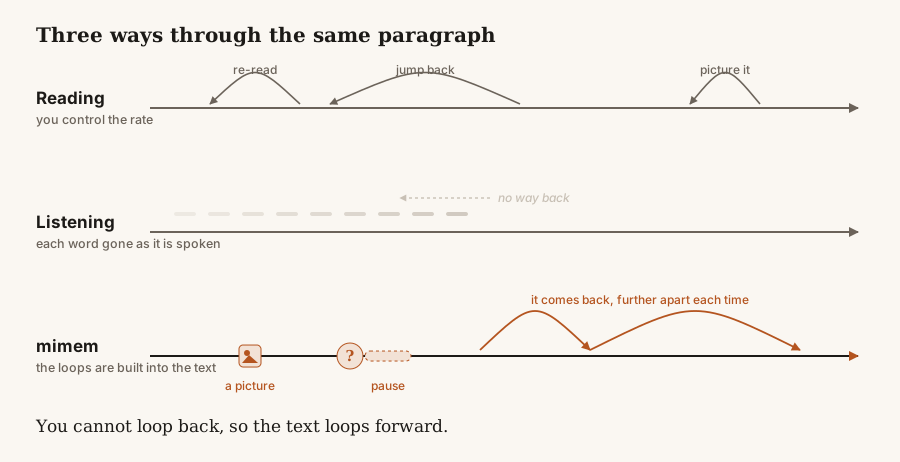
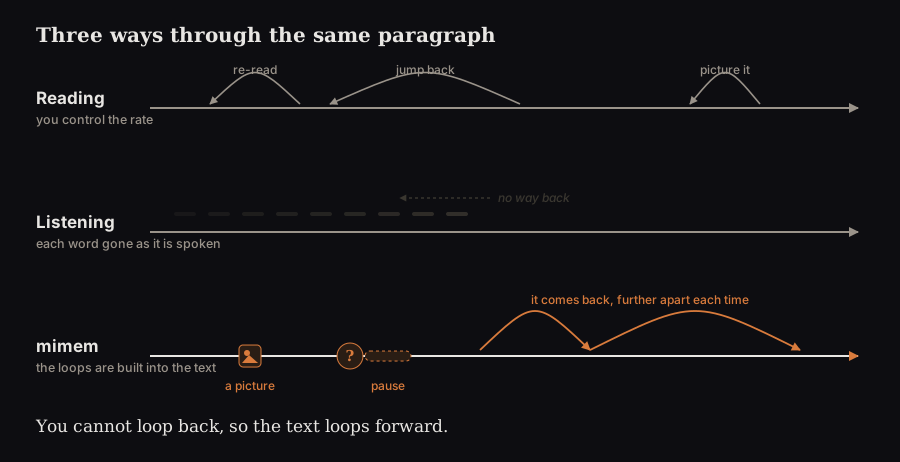
When you read, you do a dozen things without noticing. You slow down on the hard sentence. You re-read the clause that didn't parse. You jump back two pages to recover a definition. You stop and build a picture. You skip what you already know, and you linger where you don't.
Listening removes every one of those. Speech is gone the moment it is spoken, and a text-to-speech engine reading a paper aloud adds nothing in their place — it just reads faster than you can think, through the affiliations, through "open square bracket twelve", through a four-decimal percentage nobody could hold, and out the other side.
mimem rewrites the document so the text itself does what a careful reader would have done. Then it hands the result to a speech engine.
I want to listen to a paper
Install it, point it at a PDF, get a programme you can put in your ears.
Why is it built like that?
Every design decision traces to a finding about how people actually learn. Some of them are uncomfortable.
I want to work on it
Nine stages, ninety numbered rules, and a linter that fails the build.
What it actually does to a paper
Here is a sentence from a real battery paper, as a speech engine reads it:
"Electrolyte decomposition at the negative electrode leads to the formation of a solid electrolyte interphase, S E I, which passivates the surface and limits further reduction, Peled comma one nine seven nine semicolon Winter et al comma two thousand eighteen. However, the S E I is not static: repeated volume changes of the active material during…"
Four seconds of citation noise, three new concepts, a 72-word sentence, and no pause anywhere. And here is the same content after mimem has been through it:
"Part two of five. Why the battery loses capacity even when nothing breaks.
Here's a question to hold on to: when a silicon anode loses capacity, what is actually being consumed? (pause)
Two terms first. The electrolyte is the liquid that carries lithium between the two electrodes. The S E I — that's the solid electrolyte interphase — is a thin crust that forms on the negative electrode during the first few charges.
Here's a way to picture it. A cast-iron pan that seasons itself: the first heating burns a thin layer onto the metal, and that burnt layer is what stops the metal rusting further. My analogy, not theirs — and it breaks down in one place, which is the whole point of this section: a pan doesn't change size. (pause)"
The full worked example is in What a programme sounds like.
What is in there, and why
Nothing in that rewrite is decoration. Each piece is a rule, and each rule is a finding:
| What you hear | Why it is there |
|---|---|
| A question before the content | Prequestions raise recall of the material they point at (g ≈ 0.54–0.66) |
| Terms explained before they are used | Pre-training: meeting a label and a mechanism at once overloads working memory |
| A concrete image for an abstract idea | The concreteness effect is one of the most replicated findings in memory research |
| Silence after a question | A retrieval attempt needs time to be an attempt; without it the question is rhetorical |
| Ideas coming back at growing intervals | Spacing is the largest effect in the literature (g ≈ 0.74), and audio is worst at it |
| The analogy's limit, said out loud | Otherwise the listener remembers the analogy instead of the concept |
And nothing invents facts. Every sentence in the programme is either the paper's own — carrying the exact place it came from — or one of about a dozen named templates. Where a model does write something, the numbers in it are checked against the sentences it was written from before anyone hears them.
Where this is up to
Part 1 — document in, script out — is built and tested. Part 2 — speech synthesis, playback and review across sessions — is not. mimem currently produces the text a speech engine should say, and everything the scheduler will eventually need. See the plan for what is done and what is next.